
Most sewists think a power strip will protect their machines. It won’t. A UPS power backup works differently and that difference could save you thousands.
The Power Backup Every Serious Sewist Should Have
The first time my lights flickered while I was quilting on my longarm, my heart skipped a beat. What if I lost my work – my designs – my investment? I knew right then I needed more than a basic surge protector. It was time to get serious about protection for all of my machines. That’s when I started learning about Uninterrupted Power Supply (UPS).
Now, every machine in my sewing room, my longarm, serger, sewing, and embroidery machines, has its own UPS. It’s the best way I know to keep my investments and my projects safe.
Why a UPS Is Better Than a Surge Protector
A surge protector only shields your machines from sudden spikes in power. An Uninterrupted Power Supply (UPS) not only protects against surges but also gives you backup power when the lights flicker or go out. That extra power can prevent your longarm or embroidery machine from stopping mid-stitch, which could ruin your design or throw off your project, not to mention … freak you out.
For more insight into power, you might be interested in the U.S. Energy Information Administration’s Electricity hub. It tracks pricing, generation, and grid reliability, including why power blips happen, which is exactly the kind of thing a UPS protects against.
What an Uninterrupted Power Supply (UPS) Actually Does
Think of a UPS as a power safety net. It has a built-in battery that provides temporary power backup when your electricity cuts out, even for just a few seconds. It’s long enough to:
- Save embroidery designs.
- Safely pause a quilting pattern on your longarm.
- Prevent sudden shutdowns that could damage electronics.
Interesting fact: the National Weather Service keeps tabs on lightning because it’s one of the top reasons the power blinks out. Even a quick strike on a line can cause hiccup, which is exactly the kind of moment a UPS smooths over.

My UPS Setup for Every Machine
Each of my machines has a UPS:
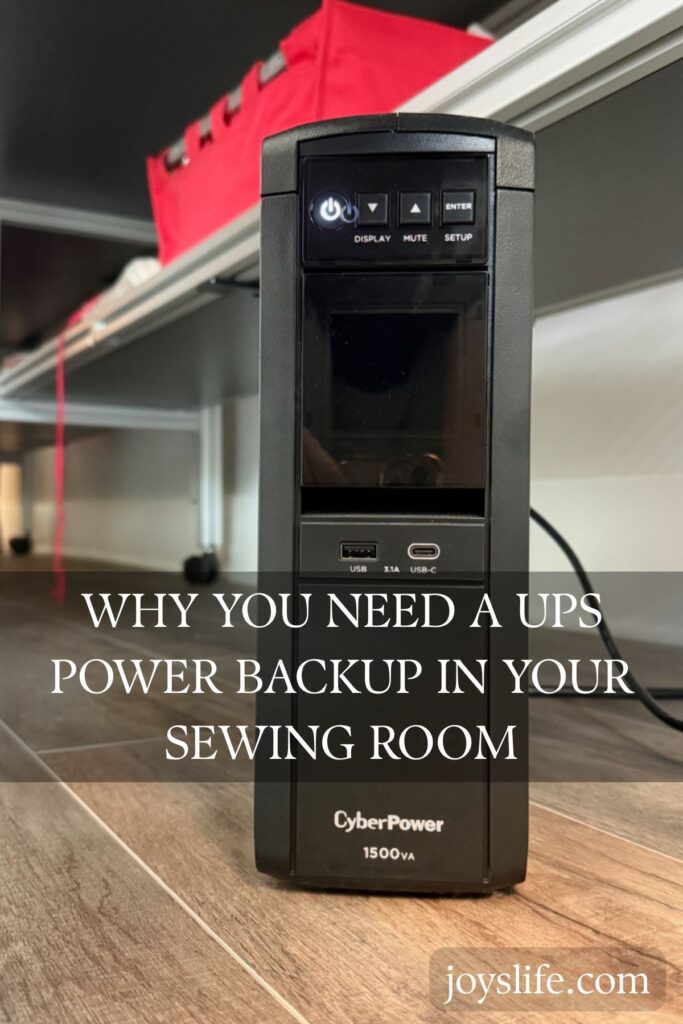
- Longarm: My Bernina Q24 with Q-matic requires a powerful UPS because it draws more energy. For it, I use the CyberPower CP1500PFCLCD PFC Sinewave UPS Battery Backup and Surge Protector. It has 1500VA/1000W, 12 Outlets, AVR, Mini Tower and is UL Certified.
- Serger: My Bernina L890 serger is high-tech with a screen but is less of a power draw than the longarm, so I didn’t need one as mighty. The serger is using the CyberPower CP850PFCLCD PFC Sinewave UPS Battery Backup and Surge Protector. It has 850VA/510W, 10 Outlets, AVR, Mini-Tower; UL Certified
- Embroidery & Sewing Machines: My Bernina 770 QE Plus uses the same UPS as my serger.
How to Choose the Right UPS for Sewing Rooms
- Size & Wattage: Match the UPS to the machine’s power needs.
- Runtime: Even 3–5 minutes is plenty to finish or save work.
- Quality: Look for brands known for reliability and quiet operation.
Why a UPS Is Worth It
Your sewing room is an investment. (I know you’re aware of those costs!) Machines, projects, and creativity all deserve protection. A UPS is inexpensive compared to the cost of repairs or lost work.
FAQS
It’s Totally Worth It
Adding an Uninterrupted Power Supply (UPS) to my sewing room was one of those, “Why didn’t I do this sooner?” thoughts. It’s not fancy or exciting like new fabric, but it’s a huge win for my peace of mind. Knowing that my longarm, serger, sewing and embroidery machines are protected means I can focus on the fun part … making stuff!
If you’ve been wondering whether a UPS is worth it, I can tell you it’s one of the smartest (and least stressful) upgrades I’ve made to my creative space. Here’s to happy stitching, uninterrupted projects, and machines that stay safe no matter what your power line decides to do!
You Might Also Like:
- Visiting the Missouri Star Quilt Company — Come along on my tour of Quilt Town, complete with themed shops, murals, and quilter inspiration.
- Sewing Machine Light That You Can Afford and Install Yourself — A wallet friendly sewing light that brightens your projects and your work area.
- Longarm Quilt Fleece Fabric with Batting — Cozy longarm quilting idea you’ll want to try, perfect for colder projects!
- Bernina Q24 Longarm Delivery Day: What to Expect — Everything I learned on delivery day, from setup to happy dance.